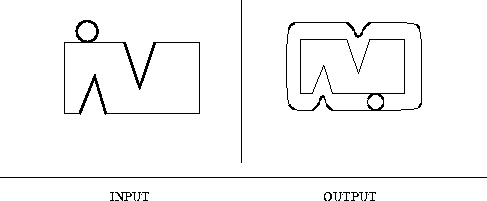

Input description: Point sets or polygons A and B, with n and m vertices, respectively.
Problem description: What is the convolution of A and B, i.e.
the Minkowski sum  ?
?
Discussion: Minkowski sums are useful geometric operations that can be used to
fatten objects in appropriate ways.
For example, a popular approach to motion planning for polygonal robots
in a room with polygonal obstacles (see Section  )
fattens each of the obstacles by taking the Minkowski sum of
them with the shape of the robot.
This reduces the problem to moving
a point from the start to the goal using a standard shortest-path algorithm.
Another application is in shape simplification
(see Section ),
where we fatten the boundary of an object to create a channel and then
define as the shape the minimum link path lying within this channel.
Similarly, convolving an irregular object with a small circle
will help smooth out the boundaries by eliminating minor nicks and cuts.
)
fattens each of the obstacles by taking the Minkowski sum of
them with the shape of the robot.
This reduces the problem to moving
a point from the start to the goal using a standard shortest-path algorithm.
Another application is in shape simplification
(see Section ),
where we fatten the boundary of an object to create a channel and then
define as the shape the minimum link path lying within this channel.
Similarly, convolving an irregular object with a small circle
will help smooth out the boundaries by eliminating minor nicks and cuts.
The definition of Minkowski sum assumes that the polygons A and B have been positioned on a coordinate system:

where x+y is the vector sum of two points. Thinking of this in terms of translation, the Minkowski sum is the union of all translations of A by a point defined within B. Issues arising in computing Minkowski sums include:
 .
Even worse is when both A and B are nonconvex, in which case
the size of the sum can be as large
as
.
Even worse is when both A and B are nonconvex, in which case
the size of the sum can be as large
as  .
Be aware that the
Minkowski sum of nonconvex polygons can have a certain ugliness to
it.
For example, holes can be either created or destroyed.
.
Be aware that the
Minkowski sum of nonconvex polygons can have a certain ugliness to
it.
For example, holes can be either created or destroyed.
Although more efficient algorithms exist, a straightforward
approach to computing the Minkowski sum
is based on triangulation and union.
First, triangulate both polygons, then compute the Minkowski sum of
each triangle of A against each triangle of B.
The sum of a triangle against another triangle is easy to compute and
is a special case of convex polygons, discussed below.
The union of these O(n m) convex polygons will be A+B.
Algorithms for computing the union of polygons are based on plane sweep,
as discussed in Section .
Computing the Minkowski sum of two convex polygons is easier than the general case, because the sum will always be convex. For convex polygons, it is easiest to slide A along the boundary of B and compute the sum edge by edge. This is the best approach for triangles against triangles as well.
Implementations: To date, we have not uncovered a suitable Minkowski sum code.
When we do, it will be made available on http://www.cs.sunysb.edu/  algorith,
the Algorithm Repository site.
algorith,
the Algorithm Repository site.
Notes: Good expositions on algorithms for Minkowski sums include [O'R94]. The fastest algorithms for various cases of Minkowski sums include [KOS91, Sha87]. Kedem and Sharir [KS90] present an efficient algorithm for translational motion planning for polygonal robots, based on Minkowski sums.
Related Problems: Thinning (see page ),
motion planning (see page ),
simplifying polygons (see page ).