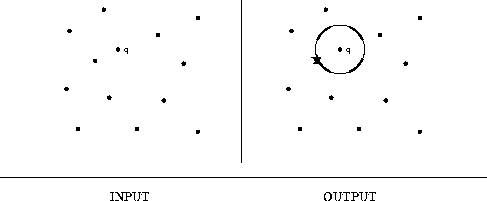

Input description: A set S of n points in d dimensions; a query point q.
Problem description: Which point in S is closest to q?
Discussion: The need to quickly find the nearest neighbor to a query point arises in a variety of geometric applications. The classic example in two dimensions is designing a system to dispatch emergency vehicles to the scene of a fire. Once the dispatcher learns the location of the fire, she uses a map to find the firehouse closest to this point so as to minimize transportation delays. This situation occurs in any application mapping customers to service providers.
Nearest-neighbor search is also important in classification. Suppose we are given a collection of data about people (say age, height, weight, years of education, sex, and income level) each of whom has been labeled as Democrat or Republican. We seek a classifier to decide which way a different person is likely to vote. Each of the people in our data set is represented by a party-labeled point in d-dimensional space. A simple classifier can be built by assigning to the new point the party affiliation of its nearest neighbor.
Such nearest-neighbor classifiers are widely used, often in high-dimensional
spaces.
The vector-quantization method of image compression partitions an image
into  pixel regions.
This method uses a predetermined library of several
thousand pixel tiles and replaces each image region
by the most similar library tile.
The most similar tile is the point in 64-dimensional space that is
closest to the image region in question.
Compression is achieved by reporting the identifier of the closest
library tile instead of the 64 pixels,
at some loss of image fidelity.
pixel regions.
This method uses a predetermined library of several
thousand pixel tiles and replaces each image region
by the most similar library tile.
The most similar tile is the point in 64-dimensional space that is
closest to the image region in question.
Compression is achieved by reporting the identifier of the closest
library tile instead of the 64 pixels,
at some loss of image fidelity.
Issues arising in nearest-neighbor search include:
 ) or if only
few queries are ever destined to be performed, the simple approach is best.
Compare the query point q against each of the n data points.
Only when fast queries are needed for large numbers of points
does it pay to consider more sophisticated methods.
) or if only
few queries are ever destined to be performed, the simple approach is best.
Compare the query point q against each of the n data points.
Only when fast queries are needed for large numbers of points
does it pay to consider more sophisticated methods.
 ,
does a very good job in moderate-dimensional spaces, even the plane.
Still, above 20 or so dimensions, you might as well do a linear
search through the data points.
Search in high-dimensional spaces becomes hard
because a sphere of radius r, representing all the points with
distance
,
does a very good job in moderate-dimensional spaces, even the plane.
Still, above 20 or so dimensions, you might as well do a linear
search through the data points.
Search in high-dimensional spaces becomes hard
because a sphere of radius r, representing all the points with
distance  from the center, progressively
fills up less volume relative to a cube as the dimensionality
increases.
Thus any data structure based on partitioning points into enclosing
volumes will become less and less effective.
from the center, progressively
fills up less volume relative to a cube as the dimensionality
increases.
Thus any data structure based on partitioning points into enclosing
volumes will become less and less effective.
In two dimensions, Voronoi diagrams (see Section )
provide an efficient data structure for nearest-neighbor queries.
The Voronoi diagram of a point set in the plane decomposes the plane
into regions such that the cell containing each data point consists
of the part of the plane that is nearer to that point than any other
in the set.
Finding the nearest neighbor of query point q reduces to finding which
cell in the Voronoi diagram contains q and reporting the data point
associated with it.
Although Voronoi diagrams can be built in higher dimensions, their size
rapidly grows to the point of unusability.
The nearest neighbor graph on a set S of n points links each vertex to its
nearest neighbor.
This graph is a subgraph of the Delaunay triangulation
and so can be computed in  .
This is quite a bargain since
it takes
.
This is quite a bargain since
it takes  time just
to discover the closest pair of points in S.
time just
to discover the closest pair of points in S.
As a lower bound, the closest pair problem in one dimension reduces to sorting. In a sorted set of numbers, the closest pair corresponds to two numbers that lie next to each other in sorted order, so we need only check which is the minimum gap between the n-1 adjacent pairs. The limiting case of this occurs when the closest pair are distance zero apart, meaning that the elements are not unique.
Implementations: Ranger is a tool for visualizing and experimenting with nearest-neighbor and orthogonal-range queries in high-dimensional data sets, using multidimensional search trees. Four different search data structures are supported by Ranger: naive kd-trees, median kd-trees, nonorthogonal kd-trees, and the vantage point tree.
For each of these, Ranger supports queries in up to 25 dimensions
under any Minkowski metric.
It includes generators for a variety of point distributions
in arbitrary dimensions.
Finally, Ranger provides a number of features to aid in
visualizing multidimensional data, best illustrated by the
accompanying video [MS93].
To identify the most appropriate projection at a glance,
Ranger provides a  matrix of all two-dimensional
projections of the data set.
Ranger is written in C, using Motif.
It runs on Silicon Graphics and HP workstations and
is available in the algorithm repository http://www.cs.sunysb.edu/
matrix of all two-dimensional
projections of the data set.
Ranger is written in C, using Motif.
It runs on Silicon Graphics and HP workstations and
is available in the algorithm repository http://www.cs.sunysb.edu/  algorith.
See Section for a complete collection
of Voronoi diagram implementations.
In particular, LEDA (see Section ) provides an implementation
of 2D Voronoi diagrams in C++, as well as planar point location to make
effective use of them for nearest-neighbor search.
A Pascal implementation of the divide-and-conquer algorithm for finding
the closest pair of points in a set of n points appears in [MS91].
See Section .
Notes: The best reference on kd-trees and other spatial data structures is two volumes by Samet [Sam90b, Sam90a], where all major variants are developed in substantial detail. Good expositions on finding the closest pair of points in the plane [BS76] include [CLR90, Man89]. These algorithms use a divide-and-conquer approach instead of just selecting from the Delaunay triangulation.
A recent development in higher-dimensional nearest-neighbor search
is algorithms that quickly produce a point that if not the nearest
neighbor lies provably close to the query
point.
A sparse weighted graph structure is built from the data set, and the
nearest neighbor is found by starting at a random point and greedily
walking in the graph towards the query point.
The closest point found over several random trials is declared the
winner.
Similar data structures hold promise for other problems in high-dimensional
spaces.
See [AM93, AMN  94].
94].
Related Problems: Kd-trees (see page ),
Voronoi diagrams (see page ),
range search (see page ).