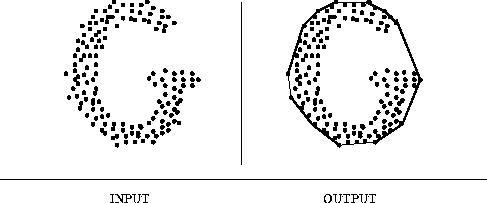

Input description: A set S of n points in d-dimensional space.
Problem description: Find the smallest convex polygon containing all the points of S.
Discussion: Finding the convex hull of a set of points is the most elementary interesting problem in computational geometry, just as minimum spanning tree is the most elementary interesting problem in graph algorithms. It arises because the hull quickly captures a rough idea of the shape or extent of a data set.
Convex hull also serves as a first preprocessing step to many, if not
most, geometric algorithms.
For example, consider the problem of finding the
diameter of a set of points, which is the pair of points a maximum distance
apart.
The diameter will always be the distance between two points on the convex hull.
The  algorithm for computing diameter proceeds by first
constructing
the convex hull, then for each hull vertex finding which other hull vertex
is farthest away from it.
This so-called ``rotating-calipers'' method can be used to move efficiently
from one hull vertex to another.
algorithm for computing diameter proceeds by first
constructing
the convex hull, then for each hull vertex finding which other hull vertex
is farthest away from it.
This so-called ``rotating-calipers'' method can be used to move efficiently
from one hull vertex to another.
There are almost as many convex hull algorithms as there are sorting algorithms. Answer the following questions to help choose between them:
Gift-wrapping is the basic algorithm for constructing higher-dimensional convex hulls. Observe that a three-dimensional convex polyhedron is composed of two-dimensional faces, or facets, which are connected by one-dimensional lines, or edges. Each edge joins exactly two facets together. Gift-wrapping starts by finding an initial facet associated with the lowest vertex and then conducting a breadth-first search from this facet to discover new, additional facets. Each edge e defining the boundary of a facet must be shared with one other facet, so by running through each of the n points we can identify which point defines the next facet with e. Essentially, we ``wrap'' the points one facet at a time by bending the wrapping paper around an edge until it hits the first point.
The key to efficiency is making sure that
each edge is explored only once.
Implemented properly in d dimensions,
gift-wrapping takes  , where
 is the number of facets and
  is the number of
edges in the convex hull.
Thus gift-wrapping can be very efficient when there is only a constant number
of facets on the hull.
However, this can be as bad as
is the number of
edges in the convex hull.
Thus gift-wrapping can be very efficient when there is only a constant number
of facets on the hull.
However, this can be as bad as  when the convex hull is very complex.
Better convex hull algorithms are available for the
important special case of three dimensions, where  time in
fact suffices.
For three or higher dimensions, I recommend that you use one of the codes
described below rather than roll your own.
time in
fact suffices.
For three or higher dimensions, I recommend that you use one of the codes
described below rather than roll your own.
 .
.
This trick can also be applied beyond two dimensions, although it loses effectiveness as the dimension increases.
The primary convex hull algorithm in the plane is the Graham scan.
Graham scan starts with one point p known to be on the
convex hull (say the point with lowest x-coordinate) and sorts the
rest of the points in angular order around p.
Starting with a hull consisting of p and the point with the smallest
angle, we proceed counterclockwise around v adding points.
If the angle formed by the new point and the last hull edge
is less than 180 degrees, we add this new point to the hull.
If the angle formed by the new point and the last ``hull'' edge
is greater than 180 degrees, then a chain of vertices starting from the
last hull edge must be deleted to maintain convexity.
The total time is , since the bottleneck is sorting the
points around v.
The basic Graham scan procedure can also be used to construct a nonself-intersecting (or simple) polygon passing through all the points. Sort the points around v, but instead of testing angles simply connect the points in angular order. Connecting this to v gives a polygon without self-intersection, although it typically has many skinny protrusions.
The gift-wrapping algorithm becomes especially simple in two dimensions, since each ``facet'' becomes an edge, each ``edge'' becomes a vertex of the polygon, and the ``breadth-first search'' simply walks around the hull in a clockwise or counterclockwise order. The 2D gift-wrapping, or Jarvis march, algorithm runs in O(n h) time, where h is the number of vertices on the convex hull. I would recommend sticking with Graham scan unless you really know in advance that there cannot be too many vertices on the hull.
Implementations: O'Rourke [O'R94] provides a robust implementation of the Graham
scan in two dimensions and an  implementation of an incremental
algorithm for convex hulls in three dimensions.
Both are written in C.
The latter has been proven capable of solving 10,000-point problems
in a few minutes
on a modern workstation.
See Section .
implementation of an incremental
algorithm for convex hulls in three dimensions.
Both are written in C.
The latter has been proven capable of solving 10,000-point problems
in a few minutes
on a modern workstation.
See Section .
Qhull [BDH97] appears to be the convex hull code of choice for general dimensions (in particular from 2 to about 8 dimensions). It is written in C and can also construct Delaunay triangulations, Voronoi vertices, furthest-site Voronoi vertices, and half-space intersections. Qhull has been widely used in scientific applications and has a well-maintained home page at http://www.geom.umn.edu/software/qhull/.
An alternative higher-dimensional convex hull code in ANSI C is Ken Clarkson's Hull, available at http://www.cs.att.com/netlib/voronoi/hull.html. It does not appear to be as widely used or actively maintained as Qhull, but it also does alpha-shapes. For an excellent alpha-shapes code, originating from the work of Edelsbrunner and Mucke [EM94], check out http://fiaker.ncsa.uiuc.edu/alpha/.
Fukuda's cdd program is the best choice for nonsimplicial polytopes in about 6D and higher. See ftp://ifor13.ethz.ch/pub/fukuda/cdd/. It may be used for computing convex hulls and half-space intersection.
XTango (see Section )
provides animations of the Graham scan and Jarvis march algorithms
in the plane.
A Pascal implementation of Graham scan appears in [MS91].
See Section .
C++ implementations of planar convex hulls includes LEDA
(see Section ).
Algorithm 523 [Edd77]
of the Collected Algorithms of the ACM is a Fortran code
for planar convex hulls.
It is available from Netlib (see Section ).
Notes: Constructing planar convex hulls plays a similar role in
computational geometry as sorting does in algorithm theory.
Like sorting, convex hull is a fundamental problem for which a wide variety of
different algorithmic approaches lead to interesting or optimal algorithms.
Preparata and Shamos [PS85] give a good exposition of several such
algorithms, including quickhull and mergehull, both inspired by the
sorting algorithms.
In fact, a simple construction involving points on a parabola reduces sorting
to convex hull, so the information-theoretic lower bound for sorting implies
that planar convex hull requires  time to compute.
A stronger lower bound is established in [Yao81].
time to compute.
A stronger lower bound is established in [Yao81].
Good expositions of the Graham scan algorithm [Gra72] and the
Jarvis march [Jar73] include
[CLR90, PS85].
The gift wrapping algorithm was introduced by Chand and Kapur [CK70].
Noteworthy among planar convex hull algorithms is Seidel and Kirkpatrick
[KS86], which takes  time, where h is the number of
hull vertices, which captures the best performance of both Graham scan
and gift wrapping and is (theoretically) better in between.
time, where h is the number of
hull vertices, which captures the best performance of both Graham scan
and gift wrapping and is (theoretically) better in between.
Alpha-hulls, introduced in [EKS83], provide a useful notion of the shape of a point set. A generalization to three dimensions, with an implementation, is presented in [EM94].
Reverse-search algorithms for constructing convex hulls are
effective in higher dimensions [AF92], although
constructions demonstrating the poor performance of convex
hull algorithms for nonsimplicial polytopes are presented in [AB95].
Through a clever lifting-map construction [ES86],
the problem of
building Voronoi diagrams in d-dimensions can be reduced to constructing
convex hulls in (d+1)-dimensions.
See Section for more details.
Dynamic algorithms for convex-hull maintenance are data structures that
permit inserting and deleting arbitrary points while
always representing the current convex hull.
The first such dynamic data structure [OvL81] supported insertions
and deletions in  time.
Expositions of this result include [PS85].
time.
Expositions of this result include [PS85].
Related Problems: Sorting (see page ),
Voronoi diagrams (see page ).