 What if you could find actionable ways to measure and improve your SEO traffic, without the BS? Read on, my friend.
One entrepreneur, Scott Krager, fed up with the difficulty of
measuring SEO decided to start building a data-driven platform to
measure SEO progress. Scott Krager is one of our top SEO experts in SEO on Clarity. Why?
- Krager has sold 5 and 6 figure websites built solely on organic search traffic
- He is the solo founder of SERPs.com, a next-gen platform for daily SEO metrics
- SERPs is used by enterprises like USA TODAY, CustomInk, and Simple to measure SEO results
This isn’t your normal SEO. Scott writes code, sells, and manages a
growing and profitable SaaS startup. He thinks 90% of SEOs are full of
crap, and that traffic, conversions and sales are the ultimate proof of
success, not some guru-speak about “visibility”.
Let’s take a look at Scott’s secrets to actionable SEO techniques to make the traffic rain…
If you think SEO is dead…stop reading.
Still here? OK good. I’m glad you still have a grasp on reality. The
more people who think SEO is dead, the less competitors you have to
worry about in Google. Win!
I’m not going to bore with you “create great content” or “put
keywords in your title tag”…that’s 101 stuff. These are three advanced
techniques that I use to boost relevant traffic to my own websites.
AdWords hack: discover the exact number of people searching for a keyword
If you only have time for one SEO bullet to fire, make it this one.
Using AdWords, you can run small campaigns to discover new keyword ideas
and see the exact search volumes of those keywords. Sure, it’ll cost a
couple of coins, but it’ll ensure you target only winning keywords in
your campaigns. #priceless
Here’s how to do it:
1. Setup a Google AdWords campaign and pick your seed keywords
Pick a few keywords you’d like to target. Need ideas? Check your analytics reports, or use a keyword research tool like ubersuggest or our meta keyword research tool.
2. Create phase and exact match keywords from your list.
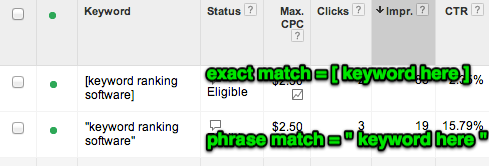 Setup each of your seed keywords as an [exact match] and “phrase match” (more about match types) keyword within an adgroup.
3. Setup conversion tracking & let campaign run a few weeks.
Make sure you’ve setup conversion tracking, so that in addition to
straight volume data, you get an even better sense of which keywords
work for you. Remember, a keyword with 500/visit a month but 2x the
conversion rate is the same value to you as a 1000/mo visit keyword.
4. Generate a “Search Terms” report
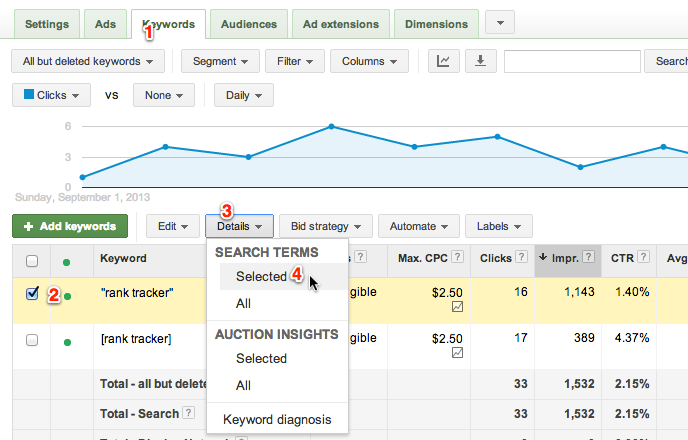 The “Search Terms” report
is the $$$ report for SEO that most people miss. It shows you all the
phrases that triggered your ads. Think of it as a goldmine filled with
keyword ideas you never even thought of.
The “Search Terms” report
is the $$$ report for SEO that most people miss. It shows you all the
phrases that triggered your ads. Think of it as a goldmine filled with
keyword ideas you never even thought of.
Here’s a short video from Google on generating this report:
Click here to view the embedded video.
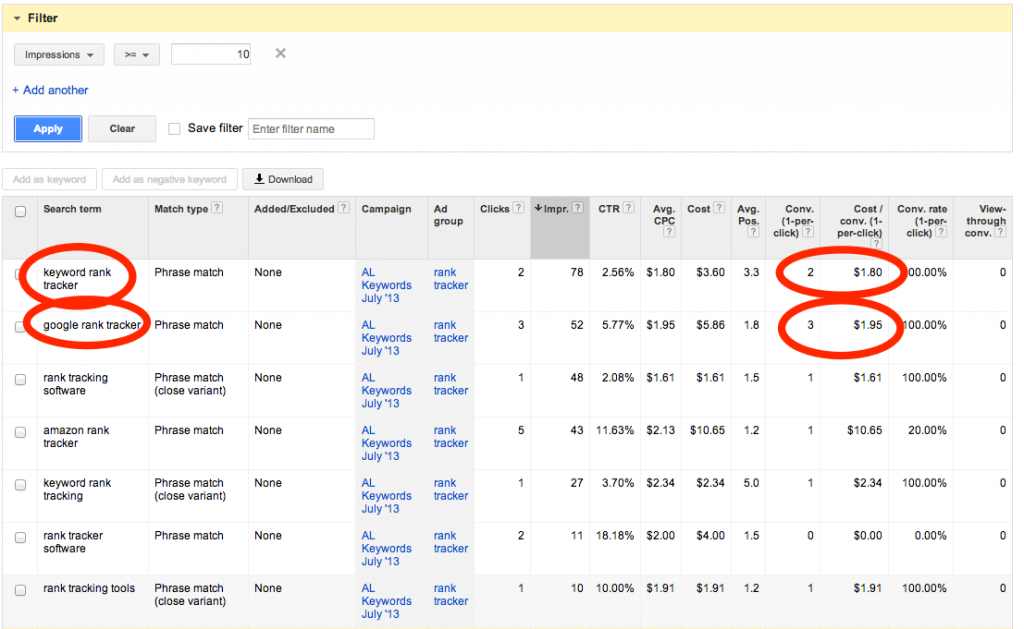
Now that you have impression (and hopefully conversion) data on these
exact keywords, no guesswork will be needed for your next SEO campaign.
And it works! For instance, I ran this report on SERPs “rank tracker”
campaign and discovered that we really should be adding “google rank
tracker” and “keyword rank tracker” based on the volume and conversion
stats. Also, we really need to add “amazon” as a negative keyword for
our PPC campaign.
5. Add the “impression share” column to your keywords report to check your numbers
To make sure that your impression numbers are accurate, add the “impression share” column to your keywords section.
This will show you how often your ad is being shown. If the % is lower
than 100%, make sure to factor that into your volume model.
SEO #winning! Alright, next.
Find your top 10 keywords that don’t rank #1 and start twerking tweaking
 Keywords
sending traffic that rank #2-15 are the often the quickest return on
SEO. These are keywords that Google clearly sees you as relevant for
already, and with a few tweaks you might be able double traffic right
away. Really.
Keywords
sending traffic that rank #2-15 are the often the quickest return on
SEO. These are keywords that Google clearly sees you as relevant for
already, and with a few tweaks you might be able double traffic right
away. Really.
1. Determine the #2-15 keywords that send traffic to you
Find your top referring organic keywords from Google Analytics and spot check your position with a free rank checker or use a dedicated rank tracking software that integrates traffic data like SERPs or Moz to get this list faster.
Record these data points:
- keyword
- traffic last 30 days
- position in Google
- ranking URL
2. Can we do on-page SEO for these keywords?
Look at the URLs ranking #2-15, and their keywords. Could you tweak a
title tag or link more internally to these pages? Follow a few simple on-page best practices.
If you’re still not #1 after your on-page tweaks you have to look at:
3. How tough is the competition above us?
If I’m ranked #5 or lower for a keyword, I like to look at what the
top #1-3 positions are doing to see what it might take to get to those
money spots.
While Google’s algorithm is of course not public, I like to look at
these factors to get a sense of the competition of a keyword:
- # of linking root domains – To get a sense of how many unique sources we might need to get links from (Moz API)
- Backlinks with this keyword in the anchor text
- % of backlinks with keyword in the anchor text
- domain authority
- page authority
- Tweets to URL
- +1s to URL
- Likes/Shares from facebook to URL
You can download or use the spreadsheet I’ve created here to record the above data points. Use ahrefs, Moz’s opensitexplorer our the Meta Site Explorer to get the data.
Measure your cost per SEO conversion
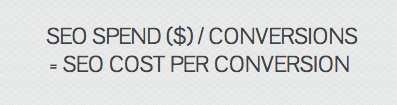
Yeah, yeah, this is a pretty simple one, but it can help drive your
SEO budget through the roof if you can even remotely calculate this. How
much did you spend on content, PR, data visuals last month? How many
organic traffic conversions did you receive? Calculate your spend and
divide that by your number of conversions from organic search traffic.
Boom! You’ve got a number to produce a ROI report on your SEO efforts.
For example we spend around $3K/month on SEO for content and PR work
and earn about 50 trials a month from organic traffic. That puts our
cost per SEO conversion at $60/trial. We value trials at around $125 a
pop, so that’s a happy number.
SEO is earned traffic, not free traffic and so, takes time and sweat
equity.The money we are spending now is an investment. By following
these tactics, I know it will be money well spent.
photo credit: Roebot
The post Make it Rain Traffic With These 3 Advanced SEO Tactics appeared first on Clarity.